Existing video security systems simply remained in the role of 'post-evidence' to record and store images. However,
Woohyun Digital goes one step further and presents a new paradigm of real-time prevention and intelligent control through
On-Device AI technology that immediately judges and analyzes the situation at the 'Edge' stage where data is generated.


It provides real-time response speed and security by performing independent AI operations inside
DVR/NVR devices without relying on external servers or the cloud.
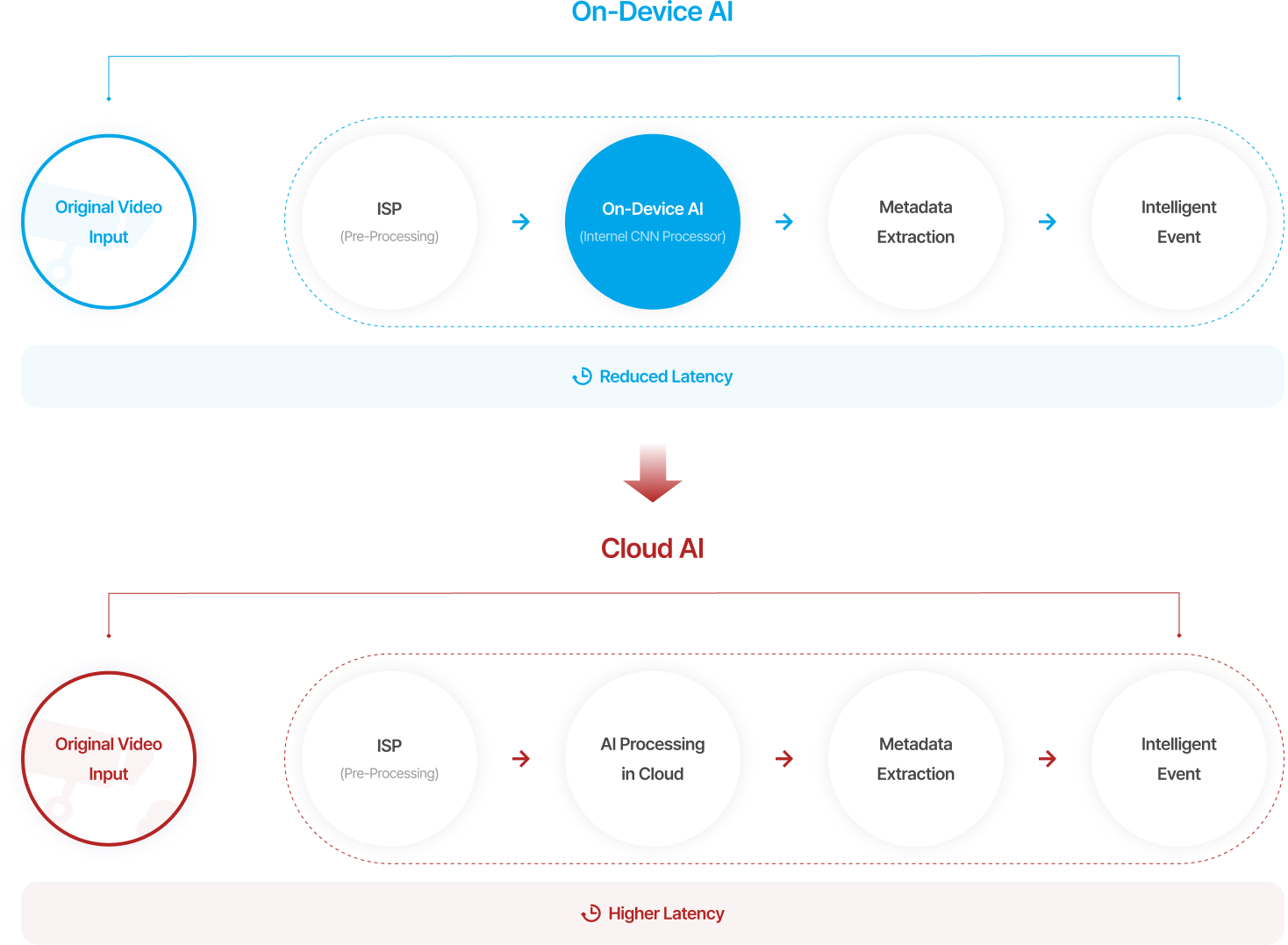
The technical distinction of Woohyun Digital lies in its optimization ability to take extreme
advantage of CNN(convolutional neural network) accelerators inside DVR/NVR.
The performance of on-device AI does not simply rely on good algorithms. Deep understanding of hardware architecture and
low-level optimization capabilities are essential to bring out 100% of SoC's NPU(Neural Processing Unit) performance in a limited
embedded Linux environment. Woohyun Digital has optimal porting technology in various SoC environments.
Universal AI models (PyTorch, TensorFlow) are too heavy and inefficient to operate on embedded devices.
Woohyun Digital redesigns the model to fit the SoC manufacturer's dedicated accelerator structure.
Fixed-point Optimization: Apply precision quantization technology to transform
floating-point models into 8-bit or 16-bit integers without performance degradation to improve computational speed.
Operator Fusion: Converts custom layers not supported by the SoC engine to standard operations or combines multiple operations to perform
hardware-optimized compilations that reduce memory access.
AI operations consume a lot of system resources. Woohyun Digital performs kernel-level tuning to parallelize AI operations without affecting the
original function (recording & transmission) of video security equipment.
Minimize internal load and latency by implementing an interface to optimize the memory copy process
when delivering ISP-acquired image data to the NPU using Efficient Memory Management.
The tight combination of image processing dedicated ISP (Image Signal Processor) and NPU (Neural Processing Unit) for AI computation helps minimize system load while
analyzing high-definition images of tens of frames per second in real time.
Firmware-Level Integration: Rather than just an application-level implant, it is designed to integrate the AI engine in the system firmware phase to enable immediate
AI analysis at the same time as the system boots.
Equipment with Woohyun Digital's On-Device AI technology performs the following high-performance
intelligent functions without a separate analysis server.
| Classification | Key Features | Expected effect |
|---|---|---|
| Object Identification | Precise classification of objects such as people, vehicles, motorcycles, etc | More than 95% reduction in false alarm |
| Behavioral Analysis | Infiltration, roaming, line crossing detection | Respond to incidents immediately and secure golden time |
| property extraction | Analysis of clothing color, vehicle number, and mask wearing | Maximize Smart Search Speed |
| Privacy | Real-time object masking (Mosaic) processing | Privacy and compliance with legal regulations |
Complete the analysis within 0.1 seconds within the device,
with no delay in sending data to the server and waiting for results.
It only utilizes metadata after analyzing inside the device without transferring the image source to an external network,
thereby blocking the risk of hacking and image leakage.
You don't need expensive high-performance analytics servers or cloud subscriptions.
Leverage existing infrastructure to upgrade to intelligent systems, dramatically reducing total cost of ownership.
Secure & intelligent processing at the device level





Beyond just selling equipment, Woohyun Digital is building an Edge-AI Life Cycle where customers' equipment becomes
smarter over time through continuously evolving AI model updates. Beyond video security,
we are expanding the scope of On-Device AI to various domains such as smart cities, smart factories, and retail analysis.
All HDMI trademarks and trade dress are registered trademarks or trademarks of HDMI Licensing Administrator, Inc.